TECHNICAL Infrastructure · Managed Service
The Recurring Technical Management Agreement
Episodic contractor work becomes sustained stewardship — the relationship inside which every other TECI practice lives.
The Recurring Technical Management Agreement is the document that turns episodic contractor work into the kind of sustained stewardship a condominium’s technical infrastructure actually deserves — and it is the relationship inside which every other practice TECI offers becomes possible.
What This Brief Is, and What It Is Not
This is not the agreement itself. The RTMA, in its operative form, is a legal document tailored to the specific property entering it. The terms vary by building size, system inventory, scope of service, and the property’s own preferences about how it wants to be served.
This brief describes the kind of agreement the RTMA is, the reasoning behind its structure, and the posture TECI brings to the relationship it creates. It is meant to be read by a property manager, a board member, or anyone evaluating whether the RTMA model fits their building. The actual contract is provided for review once the conversation has reached the point where a specific agreement makes sense to draft.
The Problem the RTMA Was Built to Solve
A condominium building accumulates technical infrastructure over decades. The systems installed in 2008 were not installed by the same vendor as the systems installed in 2018, and the systems being installed today are unlikely to be installed by the same vendor twenty years from now. Each transition creates a discontinuity. Each discontinuity erodes the building’s memory of what it has, how it was configured, and why.
The conventional model for managing this infrastructure is the service call. Something breaks; a contractor is summoned; the contractor diagnoses, repairs, invoices, and leaves. The next time something breaks, the same sequence repeats — often with a different contractor, often with no record of what was done last time, often with the building’s understanding of its own systems eroding a little further with each cycle.
The conventional model is not malicious. It is simply incompatible with the kind of stewardship technical infrastructure deserves. A building’s mechanical systems are maintained on a schedule, not by ambush. Its financial records are audited on a cadence, not when a crisis demands. Its legal documents are reviewed periodically, not only when challenged.
Technical infrastructure deserves the same dignity. The RTMA is the instrument that provides it.
What the Agreement Establishes
At its core, the RTMA establishes four commitments between TECI and the property.
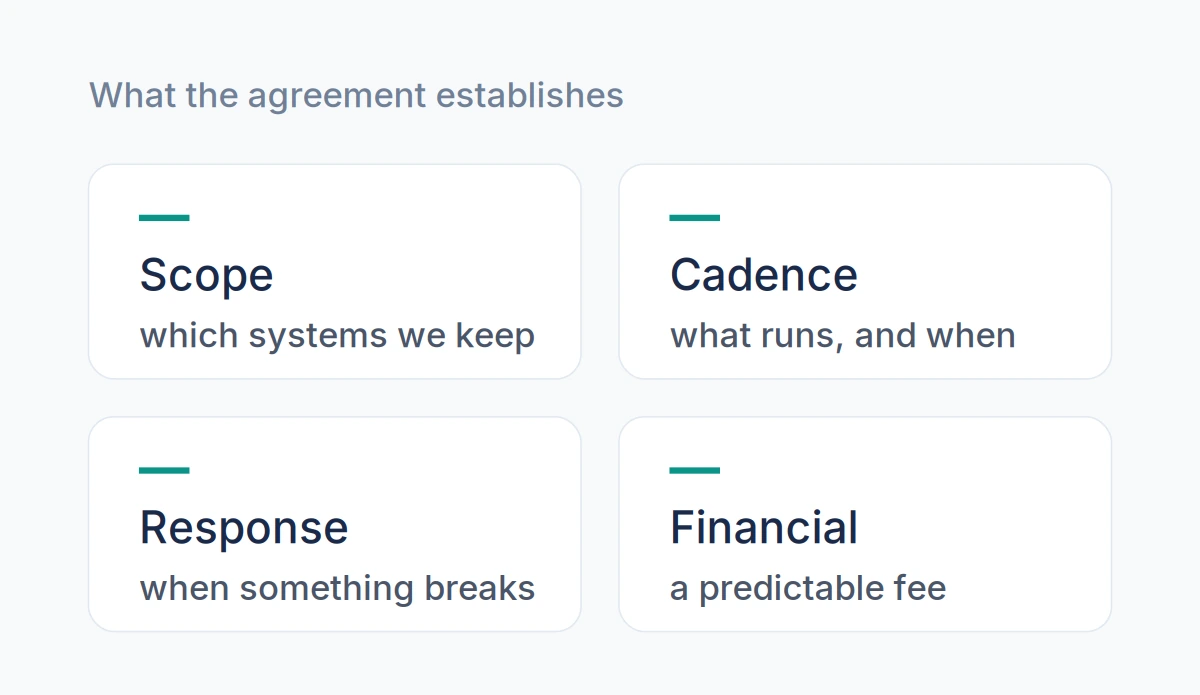
A defined scope of ongoing technical responsibility. Which systems TECI manages. Which it monitors. Which it maintains. Which fall outside the agreement and would be handled separately if they arose. The scope is explicit, written, and reviewed annually as the building’s infrastructure evolves.
A defined cadence of recurring service. What is performed monthly, quarterly, annually. Routine reviews. Audit cycles. Documentation passes. The cadence is the structure that prevents technical drift from accumulating unnoticed.
A defined response model for the unexpected. When something breaks outside the routine cadence, what happens. How a property manager reports the issue, how quickly TECI responds, what is included in the recurring agreement and what would be billable separately. The response model is meant to remove uncertainty, not to extract it.
A defined financial structure. A monthly or quarterly fee that covers the recurring scope, with billable additions for work outside that scope clearly delineated and disclosed before it is performed. No surprises, by design.
Underneath these four commitments sits a fifth, which is not legalese but is the thing that makes the agreement actually work: the commitment that the relationship itself is the product. Not the individual service calls. Not the individual deliverables. The accumulating knowledge of the building, held by one organization over years, applied to that building’s ongoing needs.
The Four Patterns
In our practice, RTMAs settle into one of four patterns. We name them so that conversations about scope can begin from a known shape rather than from a blank page.
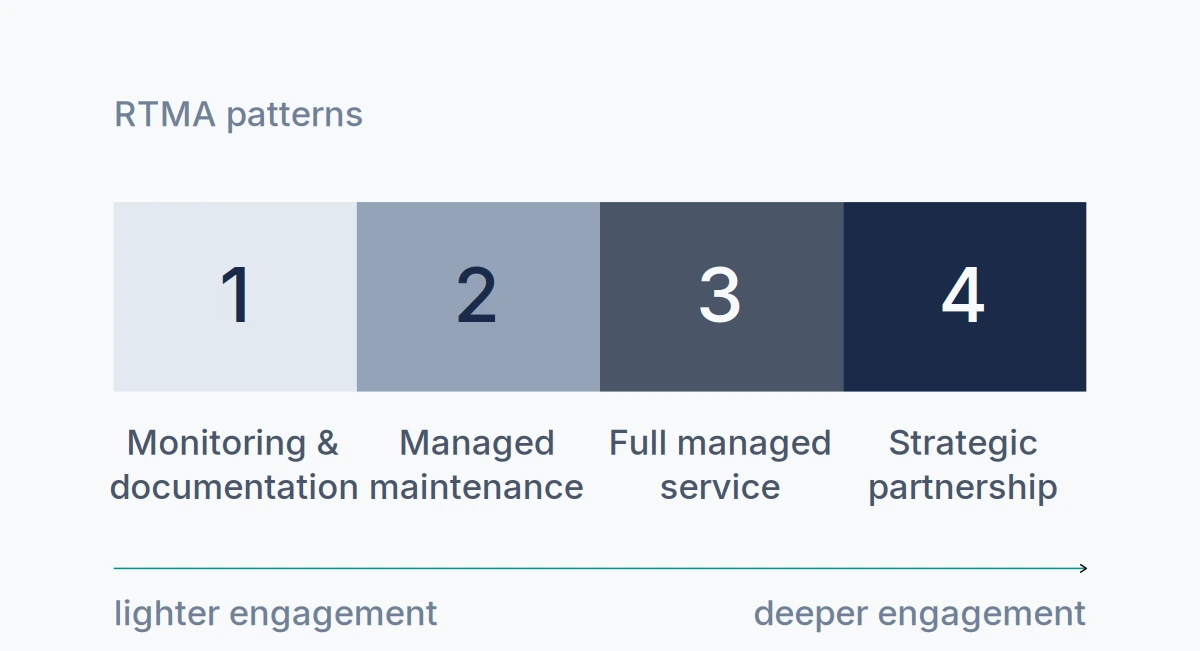
Pattern One — Monitoring and Documentation. The lightest pattern. TECI maintains the Property Tech Binder, runs the quarterly credential reconciliations and annual fob audit, and is available for consultation. Service calls are scheduled and billed as they arise. This pattern suits buildings that are confident in their existing contractor relationships for hands-on work but want the documentation discipline and the stewardship layer.
Pattern Two — Managed Maintenance. The middle pattern. Everything in Pattern One, plus TECI is the first responder for technical service calls — diagnosis, minor remediation, coordination with system manufacturers when warranty work is needed. Major repairs and installations are still quoted separately. This is the most common pattern across the portfolio.
Pattern Three — Full Managed Service. TECI is the building’s technical infrastructure department. Monitoring, documentation, maintenance, service response, system upgrades within an agreed scope, vendor relationships managed on the property’s behalf. The property’s role is governance and budget approval; the operational technical work happens inside the agreement.
Pattern Four — Strategic Partnership. The deepest pattern. Everything in Pattern Three, plus capital planning, multi-year roadmaps, and a seat at the table for board-level decisions about technical investment. This pattern is reserved for properties where the depth of relationship justifies the depth of engagement on both sides.
Properties move between patterns as their needs evolve. A building that begins at Pattern One and reaches Pattern Three over five years is not unusual; the agreement is meant to grow with the relationship rather than to lock it.
What Is Included Across All Patterns
Certain practices are part of every RTMA regardless of pattern, because the agreement would not be coherent without them.
The Property Tech Binder is maintained for every property under any RTMA. The discipline of the binder is what makes everything else verifiable.
Quarterly credential reconciliation and annual fob audits are performed for every property under any RTMA. These are the practices that hold the credential state honest.
Turnover updates for every unit changing hands are processed under every RTMA. The cadence is the value; per-event turnover discipline is what keeps a building’s credential life cycle clean across years.
A defined response window for technical incidents — varying by pattern, but always defined in writing — is part of every RTMA. The property knows what to expect when something goes wrong.
An annual relationship review is part of every RTMA. Once a year, the agreement is reviewed against the past year of actual experience, and adjusted where adjustment is warranted.
These are the floor of the RTMA. Everything else varies by pattern and by property.
What Is Not Included
It is as important to say what the RTMA is not as to say what it is.
The RTMA is not a guarantee that systems will not fail. Equipment fails. Vendors discontinue products. Power supplies expire. What the RTMA guarantees is the practice that anticipates these failures, documents them when they occur, and responds to them within a defined model. The agreement does not abolish failure; it civilizes the response to it.
The RTMA is not a substitute for the property’s capital reserve. Major system replacements at end-of-life are capital expenditures, planned and funded by the property through its normal reserve processes. The RTMA may inform those plans — and in Patterns Three and Four it actively does — but it does not replace the financial discipline of reserve funding.
The RTMA is not a lock-in. Properties terminate agreements when their circumstances change. We treat these terminations the way we treat every other transition: with the binder transferring fully and immediately to the property or its designated successor, with no retention of records as leverage. The agreement’s strength is meant to be the value it produces, not the difficulty of leaving it.
The RTMA is not, finally, a posture of dependency. A property under an RTMA should be more capable of stewarding its technical infrastructure over time, not less. The discipline of the agreement is meant to produce a building whose board understands its systems better, whose property manager can answer technical questions confidently, and whose records are sufficient to inform their own future decisions. A building that becomes more dependent on TECI year over year is a building where we have failed at the deeper aim of the work.
The Pricing Posture
We do not publish RTMA pricing in advance of conversation, and the reason is worth naming directly.
The fee structure of an RTMA is a function of the building’s size, system inventory, scope pattern, and the property’s own preferences about how the agreement is constructed. Two buildings of similar unit counts can have meaningfully different RTMA fees because their underlying systems and the depth of service they want differ. Publishing a single rate or a rate card would imply uniformity that the actual agreements do not have, and would in effect oblige us to either price for the worst case (which would be unfair to most properties) or for the best case (which would be unfair to us and would invite later adjustments that the agreement is meant to avoid).
The actual practice is straightforward. A property assessment produces a scope conversation. The scope conversation produces a proposed pattern. The proposed pattern produces a fee structure. The fee structure is reviewed and adjusted until both parties are satisfied. The agreement is then drafted to reflect what was discussed.
What we will say about pricing in general terms: RTMA fees scale with the depth of service and the technical complexity of the property. A 100-unit building at Pattern Two is in a meaningfully different fee range than a 250-unit building at Pattern Three. Both fee structures are defensible relative to the work being performed; neither is interchangeable with the other.
For properties weighing the RTMA against the conventional service-call model, the financial framing worth holding is this. Service-call accounting tends to underestimate the true annual technical cost of a building because the costs are scattered across many invoices, many vendors, and many incidents that nobody totals at year-end. An RTMA consolidates those costs into a single line item and replaces episodic charges with a predictable structure. For most properties, the total annual cost is in the same range; what changes is the predictability, the documentation, and the depth of attention.
The Relationship Frame
We have written elsewhere — in the Property Tech Binder brief, in the Turnover Updates brief, in the Fob Audits brief — that the discipline is fractal. The same care that closes a turnover ticket cleanly closes a service ticket cleanly, updates a binder cleanly, retires a piece of obsolete hardware cleanly.
The RTMA is the relationship inside which that fractal discipline becomes possible. None of the practices we describe are extractable from the agreement; they are expressions of it.
A turnover update performed by a vendor who will not be the same vendor next year is a transaction. A turnover update performed by the same vendor for the same building for ten years is the steady accretion of knowledge that makes the building’s credential history coherent. The audit, the binder, the response model — all of them gain their value from continuity. Without the RTMA, the practices become disconnected services. With the RTMA, they become a single sustained practice.
This is not a marketing claim. It is a structural fact about how technical infrastructure benefits from continuity. We have built TECI around this fact rather than around the conventional service-call model because we believe the conventional model produces worse outcomes for the buildings it serves. The RTMA is the form our belief takes.
How the Agreement Is Begun
A property considering an RTMA enters the conversation through one of three doors.
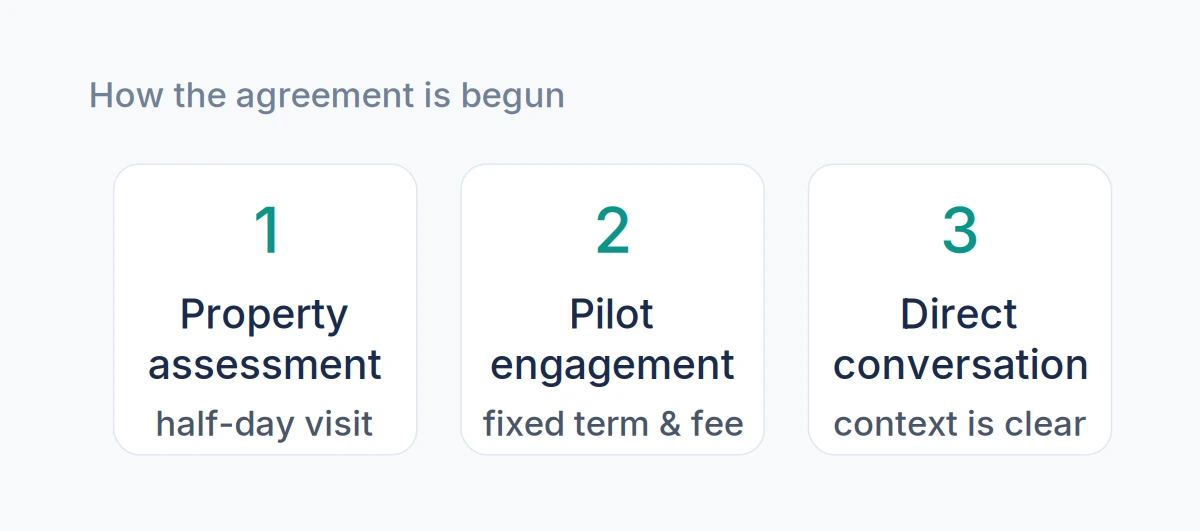
The property assessment. A half-day site visit by a TECI technician whose job is to see and document, not to install or repair. The output is a baseline document describing the building’s current technical state as we found it. This document is the property’s, regardless of whether an RTMA follows. The assessment is billed at a defined rate; the rate is disclosed before the visit is scheduled.
A pilot engagement. For properties uncertain about committing to a multi-year agreement, a defined three-month or six-month engagement covering a limited scope provides both parties an opportunity to experience the relationship before formalizing it. The pilot has a fixed fee and a defined endpoint. At the endpoint, either party may decline to continue without obligation.
A direct conversation. Properties whose situations are clear, whose timeline is pressing, or whose previous experience with TECI has already established sufficient context can begin the RTMA conversation directly. We provide a draft agreement reflecting what was discussed; the property reviews; revisions occur; the agreement is signed or it is not.
Most properties begin at the assessment, which we recommend as the cleanest opening for both sides.
How the Agreement Is Maintained
An RTMA is a living document. It is reviewed formally once a year, at a point in the calendar agreed to at the outset. At each review, three questions are addressed.
What did the past year’s actual experience look like, and how did it match the scope as written? Where the experience matched, the scope is confirmed. Where it diverged — services performed that were not in scope, services in scope that were not needed, response patterns that did not match expectation — the scope is adjusted.
What is changing about the building that the agreement should reflect? New systems being installed, old systems being retired, changes in resident demographics, changes in board priorities. The agreement should evolve with the building, not lag it.
What is changing about TECI that the agreement should reflect? New capabilities we have developed, services we have retired, refinements in our practice. The property is entitled to the benefit of these changes within the existing relationship.
The annual review is the moment when the agreement honestly faces the past year. Most reviews produce modest adjustments. A few produce significant ones. The discipline is that the review actually happens — that the agreement is not allowed to drift unexamined the way the technical infrastructure itself would drift without the discipline the agreement provides.
How the Agreement Is Ended
We have written this already in the context of the Property Tech Binder, but it bears stating directly in the RTMA’s own document.
An RTMA may be ended by either party with defined notice, the specifics of which appear in the agreement itself. When it is ended, the Property Tech Binder transfers fully and immediately to the property or to its designated successor. We do not retain records as leverage. We do not gate documentation behind final invoices. We do not believe in retention by obscurity.
This is not a magnanimous gesture. It is the only posture consistent with the position the binder takes on the property’s behalf throughout the relationship. To retain the records at termination would be to admit that they were never really the property’s records, which would invalidate everything the binder was supposed to mean during the years it was being maintained.
We accept that this posture forfeits a particular form of vendor leverage. We accept the forfeit because the alternative is incompatible with how we want to do this work.
What the RTMA Asks of the Property
A property entering an RTMA is asked, in return for the agreement’s commitments, to hold up its own end of the relationship.
To respond to communications from us in reasonable time, particularly on items that require the property’s clarification before TECI can act.
To provide accurate information about the building when asked — current resident rosters, current board contact information, current known issues and pending decisions.
To honor the cadence of the relationship. The annual review is a real conversation. The quarterly reconciliations require the property manager’s attention. The turnover notifications need to flow to us promptly. Each of these is small in isolation; together they are the rhythm that makes the agreement work.
To raise concerns directly when they arise. The agreement assumes good faith on both sides; concerns that fester silently for months are more difficult to address than concerns surfaced when they first appear. We commit to receiving such concerns without defensiveness; we ask the property to commit to raising them.
These asks are not burdensome. They are the minimum a real partnership requires.
What the RTMA Asks of TECI
The agreement’s obligations flow in both directions, and the obligations TECI takes on are worth naming explicitly.
To do the work the agreement describes, to the standard the agreement implies, on the cadence the agreement specifies. Not because the property is auditing us, but because the work deserves to be done that way regardless.
To document what we do, where we do it, and why. The binder is the artifact. The discipline of maintaining it is the substance.
To raise concerns about the property’s technical posture directly, even when those concerns are uncomfortable. A vendor who only tells a property what it wants to hear is not serving the property. The agreement’s annual review is one of the moments where uncomfortable observations are appropriate; they should not be reserved only for that moment.
To be transparent about our limitations. There are systems we do not service, manufacturers we do not represent, kinds of work for which a different vendor would serve the property better. We say so when relevant. The agreement’s value depends on the property trusting our recommendations; our recommendations deserve to earn that trust.
To honor the agreement’s termination provisions cleanly when termination arrives. No matter the circumstances of the ending, the binder transfers, the records release, the relationship concludes with the dignity it deserves.
The Stewardship Frame
There is a quieter argument running underneath the RTMA’s structure that is worth naming directly.
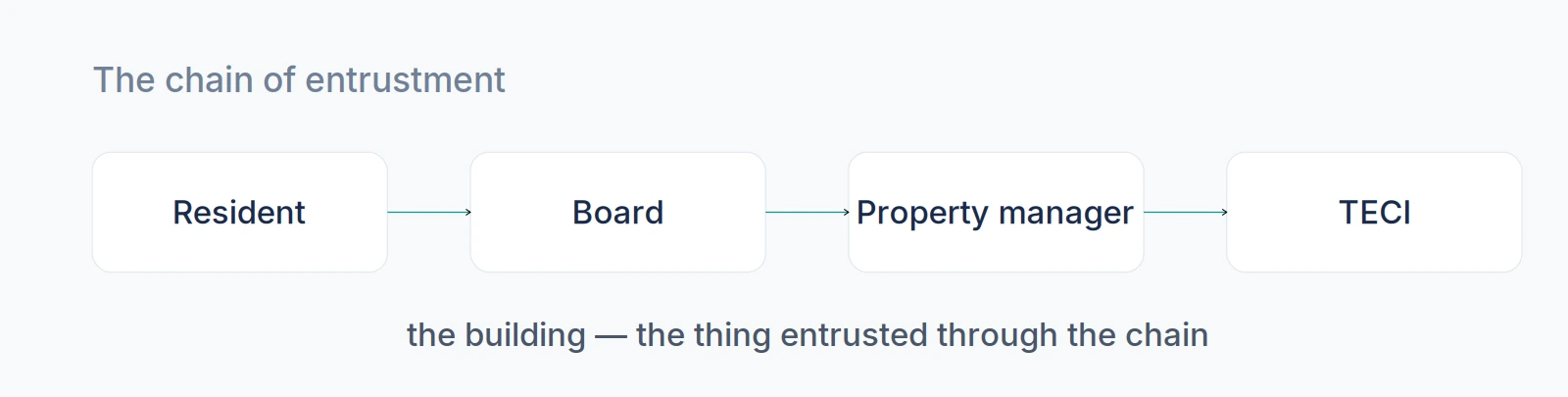
A building is an entrusted thing. Its residents have entrusted their daily living arrangements to it. Its board has entrusted its governance to the property manager. Its property manager has entrusted parts of its technical operation to TECI. The chain of entrustment runs from one party to the next, and each link in the chain carries weight that the parties do not always articulate to themselves.
The RTMA is our acknowledgment of our place in that chain. We hold technical responsibility for buildings whose residents we will mostly never meet, whose boards will mostly never need to consult us directly, and whose property managers will rotate through their roles over the years of the agreement. The building remains; the people change; the agreement’s commitments persist across the changes.
This is the posture the RTMA was built to express. Not a transaction renewed annually. A sustained commitment held over years, expressed in writing, honored in the daily work that fills the time between annual reviews.
A Note on the Catalogue This Brief Anchors
This brief is the relational capstone of a longer catalogue of TECI’s practices. The Property Tech Binder brief, the Turnover Updates brief, the Fob Audits brief — each describes a specific discipline that exists inside the RTMA. There are others beyond these three, and there will be more over time as the catalogue grows.
Read in isolation, each of those briefs describes a practice. Read together, with this brief as their anchor, they describe a single sustained relationship that the practices express. The catalogue is not a list of features. It is the surface area of a way of doing this work.
For properties new to TECI, we recommend reading the RTMA brief first and the specific practice briefs second. The order matters. The practices make sense as expressions of the relationship; the relationship does not reduce to the sum of the practices.
How to Begin
For properties already under an RTMA: your agreement is the document that governs our work together. If it has been more than a year since you have reviewed the agreement against the past year’s experience, the annual review is overdue and can be scheduled at your initiative.
For properties considering an RTMA: a property assessment is the recommended first step. A half-day site visit, a defined output document, a candid conversation about what we found. From there, an RTMA conversation can proceed with the building’s actual condition in front of both parties — which is the only honest place to start.
For properties simply exploring whether the RTMA model fits their building: we are glad to talk. The conversation costs nothing and obliges no one. It is, in our experience, one of the more useful conversations a property can have on a topic that is rarely discussed in the depth it deserves.
The Recurring Technical Management Agreement is the foundation of TECI’s managed service practice. To begin a conversation, contact us at the address on the homepage.