TECHNICAL Infrastructure · Managed Service
Turnover Updates
The quiet monthly tax on every condominium — and the discipline TECI built to make it routine instead of heroic.
Resident turnover is the quiet monthly tax on every condominium operation — and the technical work it generates is more substantial, more error-prone, and more consequential than the industry treats it as, which is why TECI built a discipline specifically for it.
The Problem We Are Naming
A unit changes hands. The outgoing resident has fobs, intercom directory entries, parking authorizations, garage clickers, and perhaps a registered vehicle plate in the gate system. The incoming resident needs all of the above re-issued, re-named, and re-authorized — and the outgoing resident’s credentials need to be cleanly retired before they walk out the door for the last time.
This happens in a typical 100-unit building somewhere between eight and fifteen times a year. Across a managed portfolio of twenty-eight properties, it happens between two and four hundred times a year. Every one of those events touches half a dozen systems and demands precision that the casual observer rarely appreciates.
When turnover is handled poorly, the consequences are not abstract. A fob that should have been retired is still active eighteen months later, in the hands of someone the building no longer knows. An intercom directory still lists a resident who moved out two summers ago. A parking authorization persists for a vehicle that hasn’t lived at the property since 2023. None of these are dramatic failures. They are quiet ones — and quiet failures accumulate.
Property managers know this. They live the consequence whenever an old credential gets used at the wrong moment. The question isn’t whether turnover discipline matters. It’s whether anyone has built the operational practice that makes it routine instead of heroic.
The TECI Posture
We treat turnover as a recurring technical event with a defined process, not as an exception to be improvised. Every move-in and every move-out is a sequence of steps — known, documented, executed, and verified — that produces a clean before-and-after state across every system the resident touched.
This is not a feature of our service. It is a category of work that justifies the recurring relationship by itself. A property that processes turnovers cleanly month after month for five years has a fundamentally different credential hygiene than one that does not.
What a Turnover Update Actually Covers
When a property notifies us that a unit is changing hands, TECI engages a defined process. The components vary by what the building has installed; the discipline is consistent across all of them.
For the outgoing resident:
- All access credentials issued to the unit are catalogued, deactivated, and logged. Physical fobs, digital credentials, mobile credentials, vehicle plate registrations — all of them.
- The intercom directory is updated to remove the resident’s name and contact information.
- Any cloud or app-based account tied to the resident’s tenancy at the property is closed, not merely abandoned.
- The property’s record of credentials-in-circulation is reconciled. We confirm what was returned, what was reported lost, and what remains unaccounted for — and the unaccounted-for credentials are added to the next quarterly audit list.
For the incoming resident:
- New credentials are issued in the appropriate quantity and type, programmed against the building’s current access scheme.
- The intercom directory is updated with the new resident’s name, suite, and chosen contact number — confirmed with them, not assumed.
- Mobile credential provisioning is offered where the building supports it.
- The resident receives a brief written orientation to the systems they will use: how the intercom works for visitor entry, how to report a lost fob, how to update their contact information.
For the property’s records:
- The credentials register in the Property Tech Binder is updated.
- The MoveIns ticket is closed with full audit trail.
- The unit’s credential history accumulates, building by building, into the long-term record.
Why It Is Not a Trivial Process
The casual reading of turnover is that it’s a clerical task — issue fobs, update directory, done. The lived reality is different.
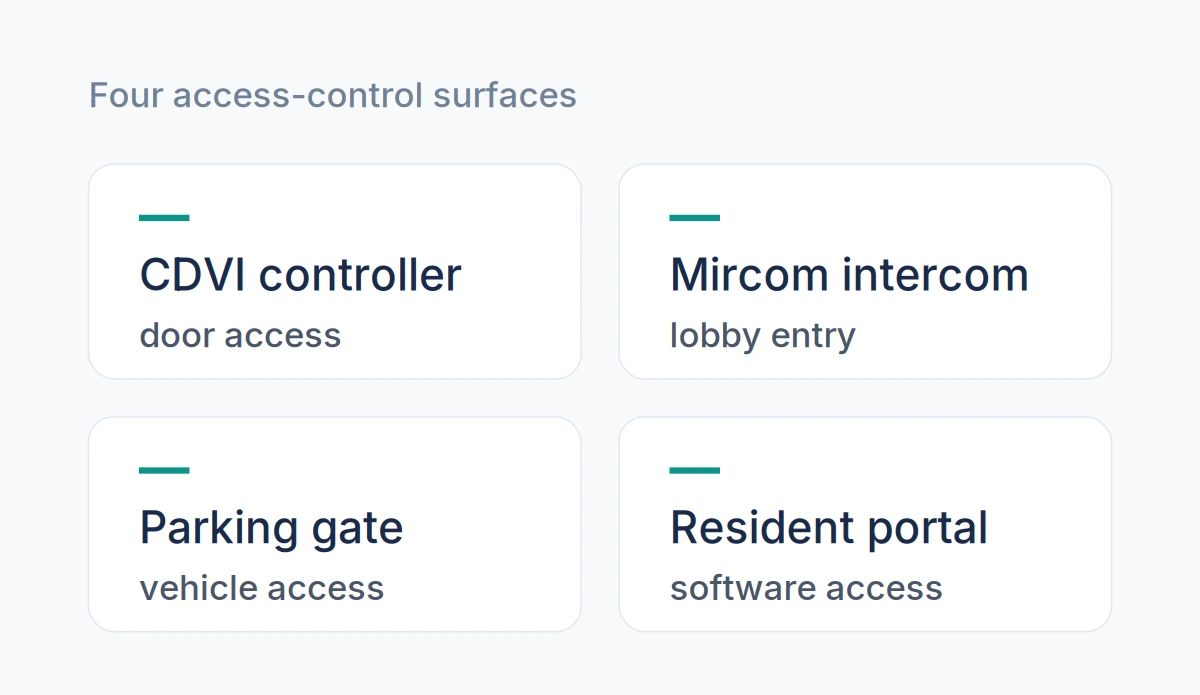
Most buildings carry more than one access system, and the systems do not always agree with each other. A CDVI access controller has one record. A Mircom intercom has another. A surface parking gate has a third. A garage door system has a fourth. A resident management portal has a fifth. Each of these has its own administrative interface, its own credential model, and its own failure mode when a record is left stale.
When turnover is handled by whoever happens to be available — sometimes the property manager, sometimes a tradesperson on another visit, sometimes the resident themselves — the inconsistencies compound. Two years of casual turnovers and a building’s credential state is, in technical terms, no longer trustworthy.
A recurring discipline rebuilds that trust. Every event is processed the same way. Every event is logged. Every event is verifiable after the fact.
How It Works Operationally
A turnover update is initiated by the property manager — typically via a short notification through MoveIns, naming the unit, the date of possession transfer, and the contact information for the incoming resident.
From there:
- A TECI technician or coordinator picks up the ticket. For most turnovers, the entire process is remote — credentials programmed from our office, directory entries updated through administrative interfaces, MoveIns ticket maintained throughout.
- If the building’s systems require on-site work — physically issuing new fobs from a property-held supply, for instance — that is scheduled around the property manager’s availability.
- The outgoing-resident decommission and the incoming-resident provision are treated as one ticket with two halves, not two separate events. This is because the failure modes are coupled: a fob issued to a new resident before the old one is retired creates a window of credential overlap that no one wants in the audit log.
- Confirmation is provided to the property manager when the turnover is complete. Not as a perfunctory email, but as a record showing exactly what was done.
Why the Audit Trail Matters
Every turnover produces an evidence record. That record is, in itself, one of the most valuable artifacts the building has — not because it is consulted often, but because it is consulted at the right moments.
When a board wants to know how many credentials are in circulation, the answer is calculable, not guessed.
When a property manager is asked by an insurer about access control discipline, the answer is documentable.
When a resident reports a lost fob, the history of what they were issued and when is on file.
When a former resident is suspected of still having access, the deactivation record settles the question.
When a property changes management or vendors, the next steward inherits a building whose credential state they can actually verify rather than reconstruct from memory.
The audit trail is the quiet asset. Most days no one looks at it. The days someone needs it are the days it earns its keep.
The Decommission Discipline
One element of turnover deserves particular attention — the decommissioning of outgoing credentials.
In our experience, this is the step most likely to be skipped or partially completed when turnover is handled informally. A new resident’s needs are visible; the previous resident’s lingering credentials are not. So the new fob gets issued and tested and the old one — physically returned or not — never gets explicitly retired in the system.
We do it the other way around. The decommission half of the ticket is closed before the provision half is opened. The new credentials issued to the incoming resident are the only credentials authorized for that unit at that moment. Anything else in the system that points to the unit’s prior tenancy is, by the time the new resident is using the building, already inactive.
This is a small discipline. It is also the discipline that, more than any other, distinguishes clean credential state from accumulated drift.
The Quarterly Reconciliation
Even with a disciplined turnover process, edge cases happen. A resident leaves without returning all the fobs they were issued. A property manager handles a turnover internally and forgets to log it. A move-out is reversed at the last moment and the records don’t catch up.
Once a quarter, we run a reconciliation pass against each property’s credentials register. The active credential list in each system is compared to the resident roster. Anomalies are surfaced to the property manager — not as accusations, but as items to clarify or close.
This pass is mundane. It is also the difference between a credential state that drifts toward chaos over five years and one that stays honest.
The annual fob audit is the deeper version of the same exercise. The quarterly pass keeps the deeper audit from ever finding a serious surprise.
What the Property Sees
From the property manager’s side, the turnover update is intended to feel routine. A short notification through MoveIns. A confirmation when it’s done. Records updated without further intervention required.
What is not visible to the property manager — and is part of what they’re paying for — is the work happening behind the notification. The reconciliation. The decommission verification. The credential register update. The MoveIns audit trail. The quarterly sweep that catches what the per-event process misses.
If the property feels nothing is happening on turnover beyond the issuance of new fobs, the discipline is succeeding. The work is meant to be invisible the way well-designed plumbing is invisible.
The Cost Question
Turnover updates are included in the RTMA. There is no per-event charge for the standard turnover process. The recurring management agreement is the vehicle that makes the discipline economically possible — neither party wants a model where the property is charged each time a resident moves and the technical work is therefore selectively skipped to save invoice lines.
Where additional costs do appear, they are predictable and disclosed:
- Physical credentials (fobs, cards, mobile-credential licences) are billed at the property’s chosen credential rate, typically passed through to the incoming resident as part of the move-in administrative fee the property manager already collects.
- On-site visits are billed at standard service rates when the building’s systems require physical presence for activation. For most modern systems they do not.
- Custom integrations or non-standard credential schemes (older proprietary systems, legacy hardware that lacks remote administration) are quoted separately at the start of the relationship.
A property that processes ten turnovers a year sees ten clean events, ten clean records, and one quarterly reconciliation, all under the standard agreement.
What the Incoming Resident Experiences
The orientation provided to incoming residents is brief by design. A page or two of clear writing, delivered by email, covering only what the resident needs to know to use the systems competently from their first day.
This is not a sales document for TECI. It is a service document for the property. The resident learns how to grant entry to a visitor through the intercom, how to use their credentials at the entry points they will encounter, what to do if they lose a fob, and how to update their directory entry if their phone number changes.
The resident does not need to know about Grover or MoveIns or the audit pipeline. They need to know how their door works. We write the orientation accordingly.
What the Outgoing Resident Experiences
Less than the incoming resident, by intention. Their tenancy is ending; the property’s relationship with them is concluding. What we owe them is straightforward: a clean conclusion to their credential history, no lingering uncertainty about whether their access has been retired, and the dignity of a process that does not require them to chase anyone.
If a credential is reported lost during their tenancy, the record reflects that. If a credential was retained and not returned, the record reflects that too — not as a grievance but as a fact the next tenant of the unit and the property’s records both deserve to know.
The Three-Year View
A property that has practiced this discipline for three consecutive years has a credentials state worth talking about.
Every active credential is traceable to the resident who holds it. Every inactive credential is documented as to when and why it was retired. Every quarterly reconciliation has produced a clean record or a known set of exceptions. The property knows what it has and who has it.
This is not a glamorous outcome. It is a foundational one. Many other technical conversations — system upgrades, audit responses to insurance carriers, board questions about security investment — become tractable when this foundation is in place. They become guesswork when it is not.
What We Ask of the Property
Three things, each modest.
First, that turnover notifications come to us promptly. A turnover we are told about on the day of move-in produces a cleaner result than one we are told about a week later, and a turnover we are told about a week later produces a cleaner result than one we are told about retroactively after the new resident has been using a borrowed fob.
Second, that the property hold to a single credential issuance pattern. If the property’s policy is two fobs per unit, every unit gets two. Exceptions made informally — a third fob for a contractor, a temporary credential for a visiting family member — undermine the audit trail whether or not they cause harm.
Third, that the property manager treat the quarterly reconciliation pass as a real conversation, not a perfunctory acknowledgment. The handful of items surfaced each quarter are worth resolving, not deferring.
The Stewardship Frame
A building’s credential state is one of the truer measures of how it is being managed. Not because anyone outside the building looks at it, but because it is the kind of detail that resists casual care.
A property whose credentials are honestly maintained is, almost without exception, a property whose other technical records are honestly maintained too. The discipline is fractal. The same care that closes a turnover ticket cleanly closes a service ticket cleanly, updates a binder cleanly, retires a piece of obsolete hardware cleanly.
Turnover discipline is one of the smaller arenas in which this character either shows up or doesn’t. We have chosen, as a company, to show up there.
How to Begin
For properties under an RTMA: the turnover update process is active. If you have not yet had a walk-through of how to initiate a turnover via MoveIns, your TECI account contact can schedule one. We recommend that the property manager and whoever handles move-in administration both attend.
For properties considering an RTMA: a credential audit is a useful first step before the agreement begins. We perform an initial pass against the building’s current credential state, surface what is unclear, and present a baseline document. The agreement that follows starts from a known position rather than from guesses.
For properties that simply want to compare notes on how turnover is handled: we are glad to talk. The discipline is not proprietary and the conversation costs nothing.
Turnover Updates are part of the TECI managed service practice. To begin a conversation, contact us at the address on the homepage or through your property manager.